
 Back to list
KISR Inaugurates the First Advanced Marine Hatchery of its Kind in Kuwait
 01 September 2026
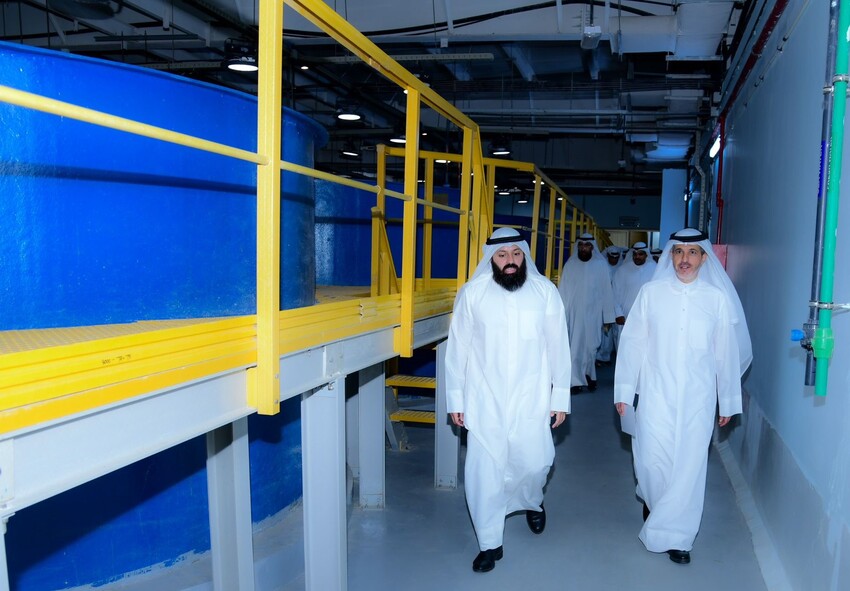
The Kuwait Institute for Scientific Research has inaugurated an advanced marine hatchery, the first of its kind in Kuwait at the Institute's Marine Research Station in Salmiya. This step marks a significant addition to the Institute's research and technical infrastructure, reinforcing its efforts to leverage scientific research and technology in service of development and food security issues.
In a speech delivered during the opening ceremony, the Institute's Director-General, Dr. Faisal Salman Al-Humaidan, stated that the hatchery's importance is not limited to its advanced technologies and equipment; rather, it extends to representing a transition of the Institute's accumulated expertise in aquaculture from research and development into an integrated system that contributes to supporting production, transferring technology, and opening horizons for new partnerships with the private sector and investors. He explained that KISR possesses decades of research and technical experience in the fields of fisheries and aquaculture, during which its researchers have worked on developing breeding and cultivation techniques for several commercially important marine fish in Kuwait, as well as improving the production of larvae and fingerlings, feeding methods, rearing, and adaptation to local environmental conditions.
Dr. Al-Humaidan pointed out that these efforts have yielded significant scientific achievements and contributed to building a scientific base and national expertise that formed the foundation for moving to a more advanced stage in this field. He noted the Institute's success in developing cultivation and spawning techniques for numerous local fish species within its research facilities. These experiences are grounded in specialized research infrastructure established by the Institute decades ago at the Marine Agriculture building in Salmiya, which houses facilities and laboratories for aquaculture, fisheries, and marine environmental research, providing an integrated scientific environment to build and develop national capacities in these fields.
The new hatchery comes as an extension of this research trajectory, designed according to modern technologies to form an integrated system starting from broodstock care and egg production, passing through live food production and larval rearing, all the way to nursery, acclimatization, and fingerling production, alongside quarantine and R&D facilities, as well as seawater treatment, recycling, and continuous quality monitoring systems. Dr. Al-Humaidan explained that the preparation and technical operation phase witnessed the initiation of productive trials to develop rearing protocols for targeted marine species, with the aim of localizing knowledge and technologies related to their production and preparing the hatchery to operate efficiently and sustainably. He emphasized that the project acquires special importance within the framework of supporting food security efforts, explaining that this concept is not only tied to current production volumes, but rather to the capability to possess knowledge and technology that allow for future production increases and sustainability.
He added that fingerling production represents one of the fundamental links in the aquaculture industry, and localizing this link in Kuwait enables the establishment of a production chain starting locally, contributing to reducing reliance on imported fingerlings, and providing a scientific and technical foundation upon which farms and investment projects can build to bring fish to fattening and commercial production stages.
Dr. Faisal Al-Humaidan highlighted the importance of this step in light of the gap between local production and fish demand, where local sources meet approximately 30 percent of Kuwait's fish needs, while the remaining percentage is met via imports. This gives the development of aquaculture a dimension that transcends the scope of scientific research, transforming it into one of the key pathways to support national food security. He explained that the hatchery also paves the way for a broader role for the private sector by providing fingerlings, transferring technical knowledge and expertise, and developing and testing technologies within the Kuwaiti environment. This creates new investment opportunities in the aquaculture sector and helps translate research and development outcomes into production sectors, converting scientific knowledge into high-value economic solutions and applications that serve national priorities.
The Director General of KISR affirmed that the inauguration of the hatchery represents the beginning of a new phase, during which the Institute looks forward to the facility becoming a national platform for research, development, production, and technology transfer, as well as a bridge for cooperation with government entities, the private sector, and investors. This will contribute to building an aquaculture sector more capable of supporting local production and enhancing food security in the State of Kuwait.